How to invest in stocks for beginners: Begin investing within 30 days

It’s important to understand that there are two main approaches to investing in the stock market. The first is passive investing, which aims to achieve the average market return of around 7-8%.

The other approach is to invest in individual stocks with the goal of outperforming the S&P 500. This approach requires more time and effort, as it involves researching and selecting specific stocks rather than just investing in a broad index. If you have any specific questions or need clarification on anything mentioned in this post, feel free to reach out to me at TomNguyen@agarwoodcapital.com.

1. Decide if you want to put in the time to beat the stock market average returns (Week 1)

Passive investing- The goal of passive investing is to achieve average stock market returns, which are estimated to be around 7% to 8% over the last 100 years. To start passive investing, it is recommended to buy a mutual fund or ETF that represents the S&P 500. This can be done through robo-advisors or standard investment advisors, who provide these mutual funds and ETFs.

Robo-Advisor Services
  • When choosing a service for passive investing, it is important to go with low-cost options such as Vanguard or Fidelity, or robo-advisors like Wealthfront or Betterment. Management costs should be below 1% of your total asset value.
    • A note about indexes: It is also important to note that different indexes represent different segments of the market. The S&P 500 represents the 500 largest companies in the US, and is therefore often used as a benchmark for the overall performance of the US stock market. Other indexes, such as the Dow Jones (DJI), only include a small number of companies and may not be representative of the broader market. This is why the S&P 500 is considered the standard benchmark instead of other indexes.

Active investing- The goal of active investing is to pick stocks and outperform the stock market average, which is represented by the S&P 500. Active investing requires putting in the time to research and analyze both individual stocks and the overall market. If you choose to become an active investor (or the DIY approach, as I like to call it), you will need to learn key aspects for analyzing a stock and strategies for ending the year with returns above the stock market average.

  1. Learning about an industry, company, and competitors
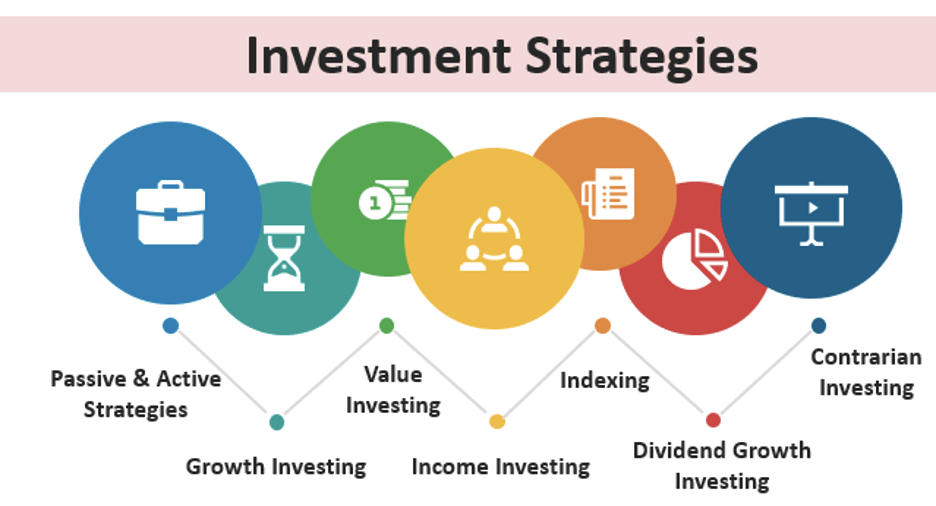
  2. Learning about investment strategies can outperform the average return 
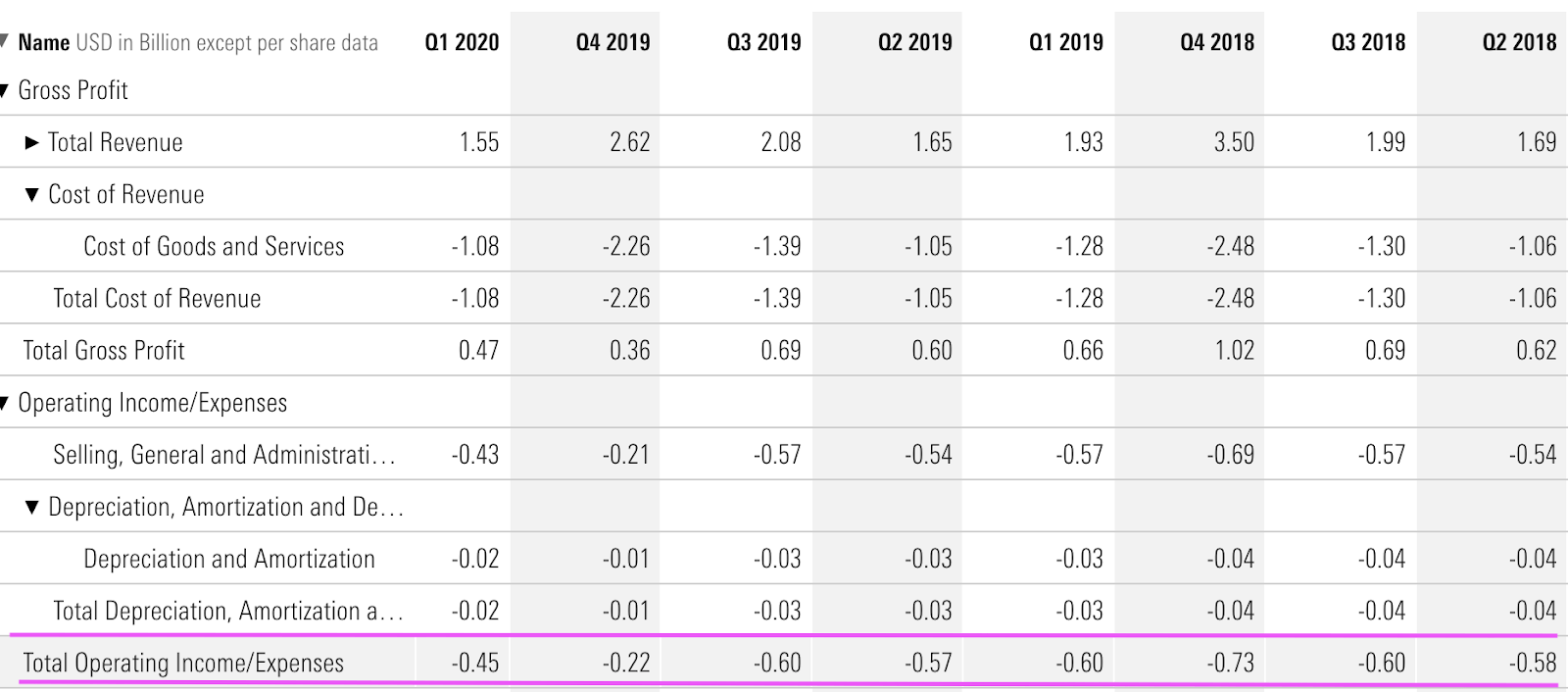
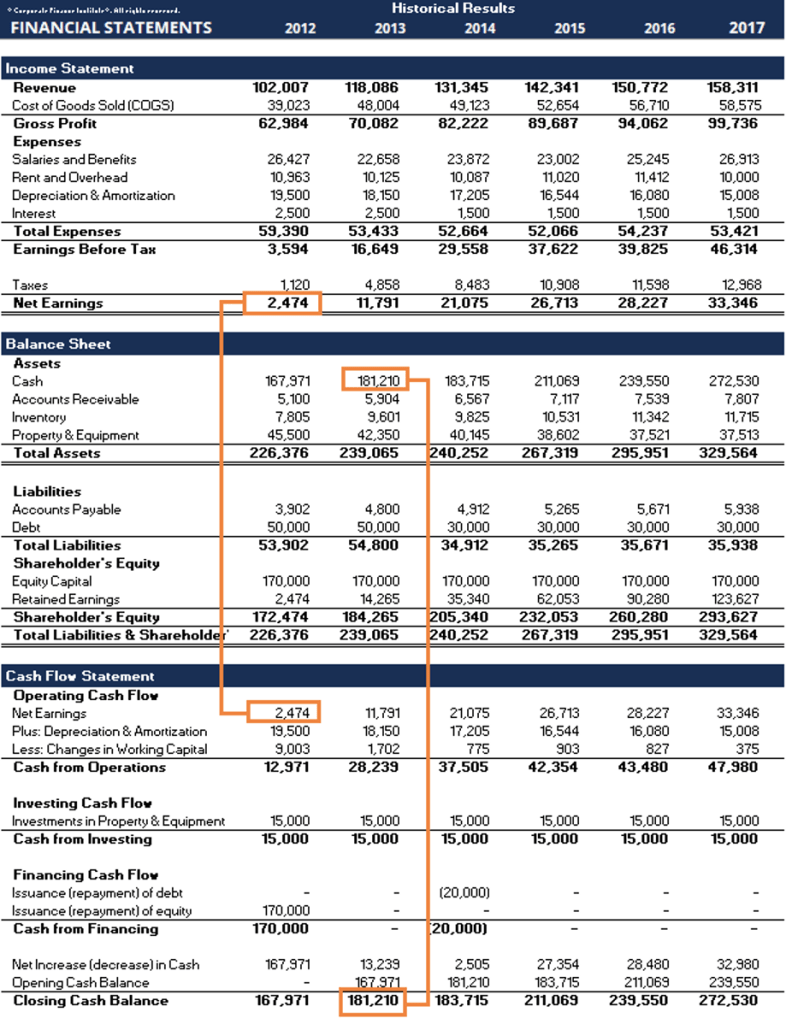
  3. Learning how to read and create financial statements

If becoming an active investor is the path you want, then continue reading.

Image result for active investing

2. Start by reading about industries and companies that are the most familiar to you. (Week 2)

It’s important to choose a business industry that is easy for you to comprehend, as this will make your investment journey more enjoyable and successful. One way to do this is to select an industry that is related to your profession or one that you have experience with through your regular purchases.

For example, if you work in the apparel industry, you may find it easier to understand the operations of an apparel company. The apparel industry is a multi-billion dollar investment opportunity, but it can also be highly competitive. To succeed in this industry, it’s important to understand the different distribution channels that are available, such as physical stores and online platforms. For example, Under Armour is a well-known apparel business that sells its products through both physical and digital channels.

As you begin your active investment journey, it’s important to learn as much as you can about the company you are interested in. This includes understanding its products, management, and business risks. It’s also a good idea to ask critical questions and do your own research to ensure that you have confidence in your investment. Remember to start with the basics and learn about the company before diving into financial statements, as this will help you to better understand the financial results. Overall, the key is to find the perfect ingredients for a successful investment by doing thorough research and asking the right questions.

Here are some initial questions I might ask about Under Armour:

  • Why is Under Amour (UA) a better investment than its competitors?
  • What makes UA better than other apparel businesses?
    • Does UA have any patents on their clothes and shoes?
  • Who manufactures UA clothes?
    • Is there a contract or partnership from the manufacturer? 
    • Why was this manufacturer selected?  
  • Who are UA shipping partners?
    • Is UA shipping partner contract?
  • Does UA have its own stores? Why does UA have its own stores?
    • How many stores does UA have?
    • How many retail partnerships do they have? 
  • Did Under Armour ship their apparel from a warehouse, and from which warehouse?
    • How did UA decide to pick this warehouse?
    • Where were the clothes made?
  • Who designs UA’s clothes?
    • What is the designing strategy, do they create athleisure clothes or not? 
    • Who’s the design team leader, how long did they work at the firm? Do they have experience at other firms?

Notice that I did not list any financial or math-related questions. The point of this exercise is to get familiar with the industry and business. As you are learning, there will be more financial jargon and it will get more confusing. Do not be discouraged. If it is confusing, you are learning.
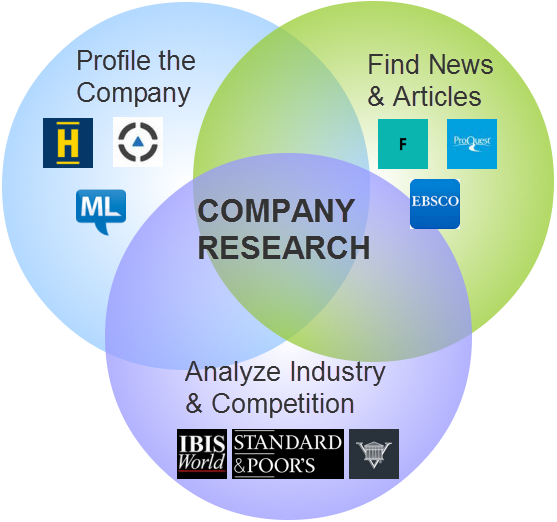
Image result for business industry and company research

3. Learn about investment strategies (Week 3)

There are many investment strategies to choose from, but one that has proven to be effective in achieving above-average market returns is value investing. This strategy involves identifying undervalued companies and investing in them with the expectation that their value will increase over time.

Value investing has been used successfully by many billionaire investors, including Warren Buffet, Seth Klarman, and Bill Ackman. It is considered a solid foundation for investors to learn about other investment strategies and can be a powerful tool for building long-term wealth. If you are new to investing, learning about value investing and how to apply it to your portfolio can be a valuable way to start building your investment strategy.

What exactly is value investing?

Value investing identifies companies with a current market price that is less than their intrinsic worth, which means the stock or company is “undervalued.”   

How do I determine the value of a stock and know if a stock is undervalued?

The discounted cash flow – this method provides the net present value by estimating the company’s future profitability to help determine the company’s values. The discounted cash flow will help provide a range of value to the entire business. 

Another way to find undervalued stocks is by using the valuation ratio. A valuation ratio shows the relationship between a company’s market value or its equity and some fundamental financial metric (e.g., earnings). The point of a valuation ratio shows the price you pay for some stream of earnings, revenue, or cash flow (or other financial metrics).

  • Price/Earnings – The historical average of the S&P 500 index P/E is 15, therefore anything under 15 could be considered undervalued relative to the historical average of the S&P 500 index. 
  • Price/Book – Price is the stock’s current market price. Book value represents what the total asset of the company is worth. So, if the price of a company is worth $100M, and the book value is worth $110M, you will see a P/B= .90 ($100M/$110M).

Not all undervalued stocks are suitable investments. Some companies may reflect undervalued but aren’t performant and stay that way. We call these value traps. A value trap will have a valuation that appears cheap, but it has risks and troubles that will cause the company to continue declining.

Understand why stocks become undervalued

  • Missed expectations and lower guidance: Shares can plunge if the company provides quarterly and annual reports that misses target earnings or provides guidance below Wall Street estimates. 
  • Market crashes and corrections: If the entire market drops, it’s a great time to look for undervalued stocks.
  • Bad news: Just like when a stock misses an analysts’ expectations, bad news can cause a knee-jerk reaction from shareholders, sending shares plunging more than they should.

Cyclical fluctuations: Different sectors tend to perform better at different stages of the economic cycle, and it can be useful to look for bargains in industries that are currently out of favor. However, it’s important to remember that not all out of favor sectors will recover or return to normal business operations. For example, the restaurant and retail industries are both known for having a high rate of businesses that go out of business.

Value investing involves looking for undervalued stocks that have the potential to increase in value over time. For example, Tesla stock priced at $200 could be considered a value stock if investors are underestimating the technology and complexity of the company, just as investors initially underestimated the software, ecosystem, and design of the iPhone when it was first released. The general concept behind value investing is to look for opportunities to buy undervalued stocks at a discounted price, similar to buying a $100 bill for $70. While value investing is a straightforward concept, it can be challenging to master, as it requires careful analysis and research to identify undervalued stocks that are right for your portfolio.

4. Learn how to read financial statements and how to create one from scratch (Week 4)

Financial statements will be disconcerting to learn. If math isn’t one of your strongest skills, it will be considerably more difficult. But, most of the investment math is simple algebra. If you cannot interpret a financial statement well, don’t rush to buy stocks. Start a stock account or paper trading account with only the amount that you can afford to lose, but still assert the same spending habits that you would with a larger account. The amount of money you need to buy an individual stock depends on your investment experience and skills. 

How do you know when you are fundamentally ready to invest? 

  • Q: Can you identify seasonality in a financial statement?
  • Q: What happens to cash flow if customers are paying with credit cards instead of cash?
  • Q: How much profit does a company have to pay off its current debt obligations? 
  • Q: Can you teach someone how to read a financial statement
The Music Will Stop for GameStop

Why does the used video game industry exist? The rise and expansion of the used game stores such as GameStop (GME) in the 1990s to early 2000s.
Collectible video games, particularly those that are rare or used, became popular after baseball cards. The proliferation of internet technology also contributed to the growth of the used video game industry by allowing for the frequent production of video games and the creation of a robust secondary market for used games. Many customers were willing to trade their completed games for new or used ones due to the constant release of new game titles.

However, both the used video game and baseball card industries lack official marketplaces, leaving customers unsure of the fair price for what they are buying or selling.

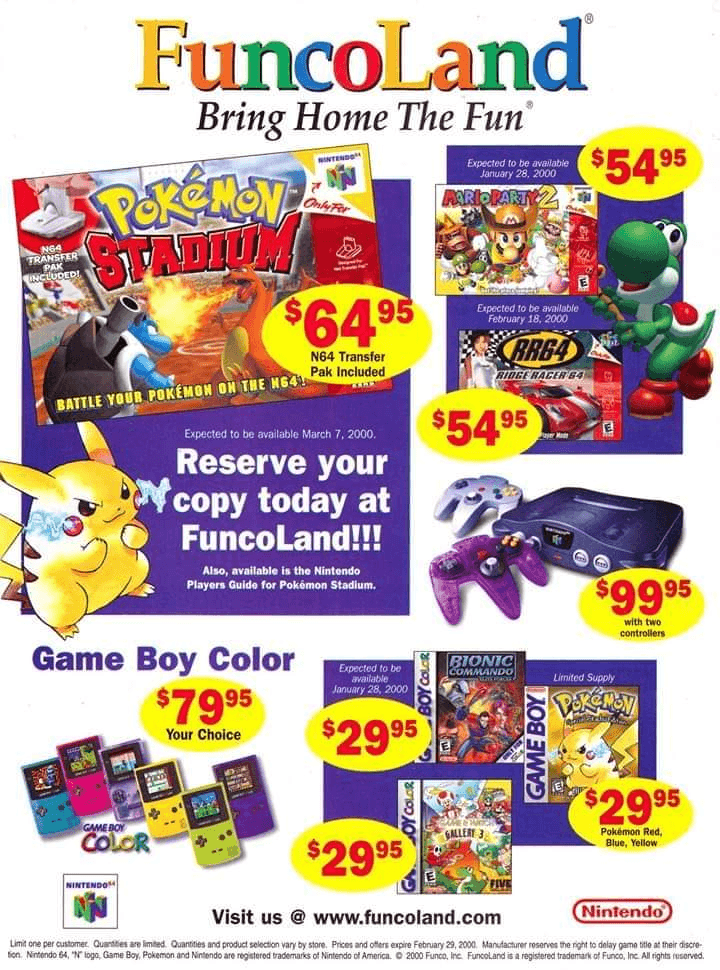
(If you want to read more about Funoland history and how it became Gamestop go here: FuncoLand History: The Company Behind Used Video Games written by Ernie Smith)

As a teenager, I loved visiting FuncoLand, a used video game and technology store that ranked second on Forbes’ list of the fastest growing companies in 1998. FuncoLand was an excellent place to purchase both new and used video games, and it also had a few consoles available for customers to try out demos. In the early 2000s, FuncoLand merged with EB Games to become GameStop.

Reason #1: Since 2010, GameStop’s business model has been in decline due to a decrease in console unit sales, weak pricing power, the increasing popularity of digital downloads, and the decreasing value of used games. In the past decade, many retailers have struggled to survive, and even specialized private equity groups that have tried to revitalize the retail industry have ultimately failed. Many retail giants, such as Bonwit Tellers, Incredible Universe, and Kids “R” Us, have either disappeared or significantly downsized. Millennials may enjoy nostalgicically reminiscing about the 90s, but they are not likely to shop at GameStop due to its high prices, inconvenient locations, unethical business practices, and lack of authenticity. All niche communities are built on authenticity, and when GameStop changed its name and business model, it lost that authenticity as well.

Management has speculated that the release of new gaming consoles will help to boost sales in 2020. However, in the most recent quarter of 2019, GameStop’s CEO, George Sherman, was surprised by the steep decline in sales. There are now too many GameStop stores, and new and used games can be found much cheaper elsewhere. Some bullish investors believe that GameStop will automatically recover sales through the new gaming console cycle. However, over half of GameStop’s console market opportunities have vanished between 2008 and 2020. In 2008, a total of 90 million consoles were sold worldwide, while estimates for 2020 range from 30 to 40 million.

Overview

The Global Unit Sales of Current Generation Video Game Console in million units (2008 to 2017)Infogram.

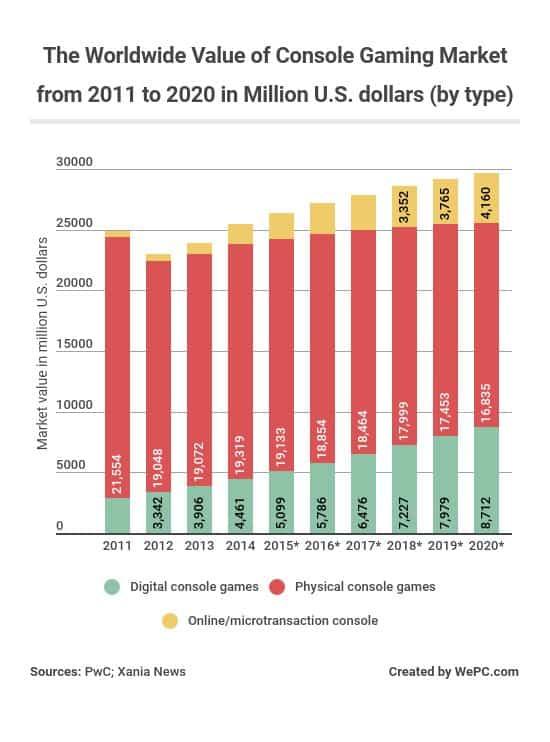
  • Used games are becoming less valuable each year, while digital downloads are becoming more popular. Used games are still a significant source of income for GameStop, but its sales in that category have declined every year since 2011. In 2019, Sony sold over half of its games through downloads. Microsoft, Nintendo, and Google have all invested heavily in online gaming.

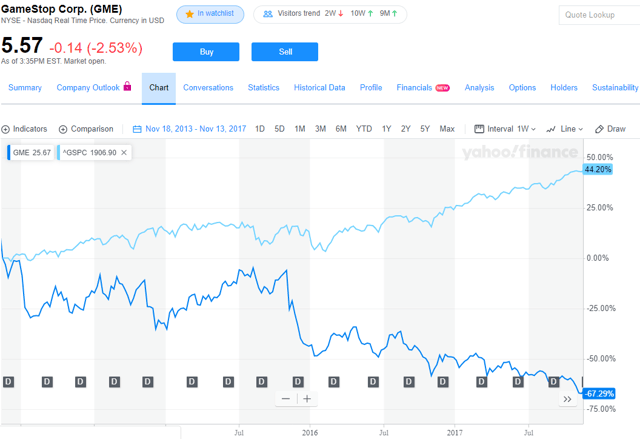
Playstation 4 was released on Nov 15, 2013. GME stock from Nov 2013 to Nov 2017 is -67%

  • GameStop’s supply chain and marketing tactics are some of the worst in the retail industry: They do not offer free shipping unless the total purchase is over $50, while their competitors are upgrading their businesses with robotics, software, and logistics innovations
  • Corporate culture is toxic, and the business execution is mediocre: The gaming community is well aware of GameStop’s deceptive business practices. It is unclear what could make GameStop more successful than its competitors. In fact, it seems highly unlikely that the company’s management plan could result in success.
Image result for gamestop fail"
  • Weak pricing power: New and popular games from other retailers are often discounted 10% less than Gamestop’s prices, and customers who use the retailers’ branded credit cards receive an additional 5% off. Additionally, used games can be found more cheaply on platforms such as eBay, Facebook, and Craigslist.
    • GameStop cannot compete against cheaper alternatives: Major retailers are willing to take losses on gaming discounts in order to build brand loyalty and make up the difference with higher-margin products. GameStop has therefore resorted to offering creative membership deals that may mislead customers into paying more for used games.
    • Used cheap games are recession-proof, not expensive used games: During a recession, consumers tend to look for the cheapest options rather than paying more for discretionary goods. Therefore, GameStop’s trade-in value may not make economic sense to many customers, as they can get a better value for their games through online retailers or platforms such as eBay, Facebook, or Craigslist. There are multiple ways to sell and buy games online that are more convenient and have considerably better prices.  The cost of shipping video games is really affordable, and you will still make more money selling games on eBay than you would at GameStop.
  • It’s not convenient to drive to a game store. Furthermore, it is more convenient for customers to buy games from larger retail stores where they can also purchase other items, rather than making a special trip to a game store. The supply of used video games is plentiful and it is easy to find popular titles from other marketplaces.
  • Lack of Customer Service & Knowledge GameStop’s customer service and knowledge may also be lacking, as the company has unrealistic sales goals and uses forceful sales tactics. Its membership points system may also be confusing and misleading.

2. History of Poor Capital Allocation – Low ROIC, no investment in business and waste of share buybacks.

  • Aggressive share buyback won’t work: GameStop’s aggressive share buyback strategy has been ineffective since 2010, costing the company over $400 million in share repurchases. This amount does not include the additional $120 million in buybacks from 2019. A company should only repurchase shares if it has sufficient funds to support its operations and the stock is selling at a significant discount to its calculated intrinsic value. However, GameStop is projected to run out of cash by the end of the year and will have to rely on high-interest credit to finance its operations.
  • Liquidity Fallacy: The “liquidity fallacy” argument, which suggests that as long as customers continue to shop at GameStop, cash flow is not an issue, is flawed. While investor Michael Burry is well-versed in liquidity and cash flow, he and other investors failed to consider the cultural significance of the gaming community to GameStop’s business. Customers are the most important asset on GameStop’s balance sheet, not dollars. Just as Sears had enough liquidity to implement a turnaround strategy, but ultimately failed due to a lack of customer demand, cutting costs too deeply can negatively impact the customer experience and ultimately hurt the company’s financial performance.
  • Fallen ROIC since 2014: Despite GameStop’s falling return on invested capital (ROIC) since 2014, due to a lack of significant investments in the business in recent years, Burry still identified it as one of his top investment ideas. It is unsurprising that investors may believe their skills and knowledge are transferable across industries, but in the constantly evolving world of gaming and retail, it is important to carefully assess all factors that could impact a company’s success.
Historical 10 year ROIC of GME

3. Proposing unproven Strategies – gaming events, retro games, and merchandise will not replace the loss of used games revenue.

  • Store gaming events are not proven strategies: Management has not provided information that shows gaming store events could create profitability. Most GameStop stores are simply too small for hosting gaming events. GameStop had a press release about their gaming events in Spring 2019, and it has been quiet ever since.  GameStop probably has already failed its first gaming event attempt. The best gaming hosts in the industry are only mildly successful.
  • Increasing retro and rare game sales will not stabilize revenue: Rare games sell on eBay at a much lower price than GameStop trade-in value. Collectible games will slow down the turnover inventory and they will take up shelf space from other, newer products.

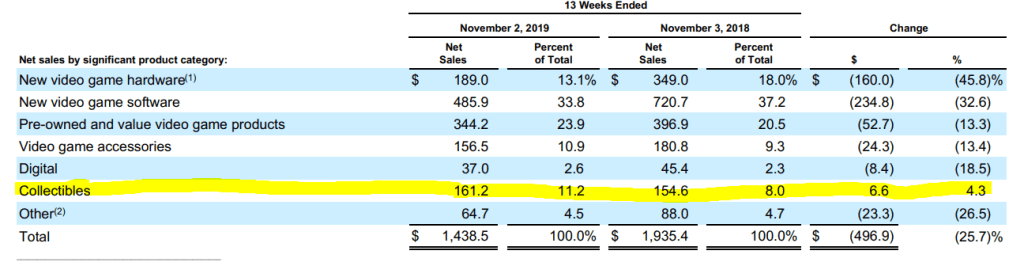
Shifting sales to nongaming merchandise will turn GameStop into another commodity store: GameStop owns the ThinkGeek store that sells nongaming merchandise and its sales are going down too. GameStop eliminated the position of Chief Operating Officer (COO) and in recent months has begun to switch some of its business models toward collectibles and trading merchandise. In other words, GameStop is basically converting its store into another failing business: its sister brand ThinkGeek. GameStop’s best non-selling items are Bubbleheads that are made by Funko.  Gimmicky products like Bobbleheads are the beanie baby 2.0… Bobbleheads have high-net income margins, but it doesn’t add any value to GameStop. GameStop may get some foot traffic from Bobbleheads, socks, T-shirts, and other random merchandise, but total sales are simply not good enough to offset their declining game sales. In the early 90s, trading card stores attempted to switch from baseball cards to other popular merchandise, but eventually, the hobby store industry disappeared.

Gamestop is hoping for Collectibles to turnaround the company

Valuation Verdict:
GME at its best would be worth $5/Share, assuming a small decline of -2% revenue CAGR and an average 3% EBITDA Margin.  Bullish investors estimate GameStop valuation between $6 to $10, but it doesn’t require complex math to explain GameStop’s valuation. Analysts are overcompensating on complex valuation because they believe used video games can be a sustainable business model. The next 12 months will be critical for GameStop to improve its revenue or else the stock price will take a nose dive. 

GameStop has less than one year to prove to investors that they can stabilize and improve sales. GameStop currently holds $290 million in cash and $419.4 million in debt. GameStop has had many years to turn around the company, but they have just burned through cash to buy back a company that offers customer zero value. Buybacks are great if the company is greatly undervalued and if it receives enough funds to support both business operations and buybacks. In GameStop’s case, it only has adequate money to pay down debt or buy back shares.

GME will drop to $3 again and become a penny stock in the next two years. Private Equity dry powder is at an all-time decade high, and there is still no offer for GameStop. Based on the last 4 quarters, GME is projected to lose a minimal of $160M to $200M in 2020.

Conclusion:

The existence of GameStop came from the void of the used game market. The industry has evolved and that used game void is available through multiple channels that offer cheaper prices and better value.

A new generation of game consoles is arriving later this year, buying GameStop sometime to hold out. The question remains, how much longer can GameStop’s business model remain relevant in a fast-growing digital distribution era? Get ready to say Rest In Peace, as GameStop will join its non-innovative retail family members in bankruptcy shortly.

Can’t stop, won’t stop, Gamestop selling drops ’cause it, it gets down baby, it gets down baby

The GameStop, gameflop, and StockDrop

Collectibles arbitrage in the 1970s-1990s: The rise and fall of hobby stores

Before the internet, auctions, and hobby stores existed, it was a simple market for collectibles such as shoes, artwork, games, and cards. However, the market was not efficient in pricing collectibles for hobbyists.

It was difficult to find rare cards and they were only available through newspaper ads, neighbors, acquaintances, and hobby stores. Rarity was determined by the availability and location of a product. Baseball cards gained popularity in the 1970s to 1990s and led to the creation of new hobby stores to sell them. Baseball cards were cheap to produce and could be sold for a significant profit.

Image result for hobby cards stores in 1990s"
By the early 1970s, the first professional card dealers emerged

During the dial-up internet era in the late 1990s, consumers were not familiar with the internet and were skeptical of buying products online. As a result, they trusted local hobby stores more than the internet. Hobby stores took advantage of this by selling the same merchandise at higher prices due to the customer’s mistrust of internet products.

I often paid a premium price at the store rather than the “official card price index” listed in hobbyist magazines. It was not easy to buy from the internet because there was no way to confirm or guarantee that the money paid online would be honored. It was common for hobby stores to list merchandise at higher prices than the market’s selling price.

As time passed, consumers began to trust online marketplaces like eBay, and collectibles became more price efficient. Sports card revenues reached their peak in 1991 at $1.2 billion, but since then have dropped to under $200 million as hobbyists lost interest in baseball cards. The saturation of hobby stores reached its peak when store owners realized there were more baseball cards than they could sell. As a result, hobby stores started looking like storage rooms and most baseball cards lost their value.

Image result for baseball card stores junk"
Baseball Cards Liquidation sale

Experienced store owners who recognized the decline of baseball cards quickly sold their entire inventory and stores. The market clearly showed that baseball and collectible cards were not worth much. Smart hobby store owners were able to make a decent profit and shift their attention to the next collectible trend. However, those who took over the hobby stores ended up holding the bankruptcy bag.

The Millennial ‘Frugalpreneur’ Lifestyle

As millennials and Gen Z enter the workforce, it’s important to adopt a frugal mindset in order to manage finances effectively to live the ‘Frugalpreneur’ lifestyle, keeping the largest expenses as low as possible. Many successful entrepreneurs have kept their expenses low in order to finance their businesses, and by adopting this mindset you can achieve financial success. It is important to make smart financial choices and avoid purchases that don’t add value to your life.

There are many overpriced “brand activities” in a society that put pressure on millennials and impose expensive social obligations on them. Social branding activities such as weddings, cars, luxury goods, independent living, travel and many others are responsible for Millennials’ financial stress. Who would you like to impress? In fact, most of these branding tactics are just ways for companies to make money, they usually do not add value to your life. If you can afford the social brand image, do it wisely, but don’t go into debt.

The average salary of millennials ranges from $60,000 to $100,000 per year. HENRY (High Earners Not Rich, Still) Millennials make $100,000 or more. Saving and investing in your early career might not look like much, but just wait until you reach your 30s. Millennials and Gen Zs, listen to me if you want a better financial life: your priorities must change. Money cannot solve personal life problems, but financial flexibility can relieve some of life’s difficulties. Utilize your money for purchases that will add the greatest value to your life at the best price. Living an intelligent financial lifestyle doesn’t look sexy because society is driven by marketing your life into perpetual spending habits with overrated experiences, temporary homes, and worthless cars.

Living independent – Very Overrated 

Living independently can be a very overrated concept, and there are several reasons for this. One of the most straightforward ways to save money is to live with your parents or have a roommate. Rent is typically one of the highest recurring expenses, so cutting down on it can make a significant impact on your budget.

Society may often put pressure on millennials to live independently, but living with your family or having roommates can actually be a sign of maturity and good financial decision-making. Even if you are making a good income, it may still be more cost-effective to live at home or with a roommate rather than paying for an expensive apartment on your own. Unless there are specific issues at home, living with your family can be a smart financial decision that can help you save money.

Many millennials feel pressure to live independently and may go into debt in order to impress others with their financial status. However, these types of expenses, such as renting an apartment or buying a new car, do not necessarily add value to one’s life beyond the illusion of financial success.

A colleague of mine, Kevin, once asked me how I could afford to eat out for lunch every day. Kevin had lived with roommates for two years before renting a one-bedroom apartment in Arlington, VA for $2,300 per month. It’s worth considering whether the expense of living independently is worth it, and whether it’s possible to make more financially sound decisions that can benefit your long-term financial health.

Kevin’s background: Kevin lived with roommates for two years, and then rented his own one-bedroom apartment in Arlington, VA for $2,300 a month. 

Kevin: “Tom you are wasting a lot of money eating out.” 

Tom: “How much are you saving from not eating out?”

Kevin: “$200 a month” and he showed a big smile. 

Tom: “Wow that’s great, but I like eating out. I am sacrificing my personal space to live with roommates.” 

Kevin: “Oh you’re saving a lot of money living with roommates, I can’t do that though. I want my own space.”

Tom: “Yep, I am saving a lot of money,” I flashed a big smile back to Kevin and went out to lunch.

How much was I saving from living with roommates? 

$0 Dollars – I never had to pay any rent.

During college and my first two years on the job, I paid $600 a month to live with my family. I saved much of my money in order to eventually buy a house. After saving up for a deposit, I was able to purchase a townhouse near a university campus. My mortgage was $2000 a month and my homeowners association (HOA) fees were $100 per month. I wasted no time in posting available rooms for rent. I lived on my own for less than a month before I had a college roommate who moved into my house. Within the second month, all the rooms were rented. There were times when I rented out my own bedroom on Airbnb and slept on the sofa. This may seem extreme, but it helped me save money more quickly.

While some people have had bad experiences living with roommates, it is understandable that it may not always be convenient. It takes time to interview potential roommates and ensure they have good etiquette.

I am not saying that millennials have to live with their families, but who do they want to impress? You can always live independently with your family by paying rent and helping to care for the home. If living with family is not a viable option, then look for a good roommate.

If you want to live independently, consider renting an affordable basement and sharing a kitchen. Whatever you do, try to minimize your rental expenses as much as possible. Saving money on things like coffee, eating out, and being frugal with other smaller discretionary expenses does not compare to saving money on rental expenses.

Traveling often – Overrated

Traveling is great, but why are millennials traveling so often? There should be a budget set for traveling. I am worried about my generation that is taking out loans and paying interest to travel more often. Does traveling often add value to anyone’s life? It could, but at what cost?

Eating out – Underrated

I can’t eat simple prepared meals like sandwiches, pizza, etc. I prefer meals that have a richer taste, which means they take longer to cook. I have to spend a lot of time grocery shopping, preparing, and cleaning just to make one meal. To me, it’s not worth the time to cook unless I’m cooking for a household of at least three people. The economic cost and time required to prepare a meal are wasteful. It would be just as affordable, and sometimes cheaper, to eat out than to make the food at home.

10% minimal saving & 10% Retirement – Very Underrated

It is important to pay off your discretionary debt that has an interest rate above 5%. This includes paying off your credit card balances in full each month. There is no reason to carry a balance from month to month.

Once you have paid off your credit card debt, it is a good idea to start saving 10% of your income each month. However, it is not advisable to simply leave your savings in a regular savings account. Instead, consider investing your savings in a higher-yielding account, such as a stock market index fund. Avoid picking individual stocks unless you are well-educated in investment fundamentals, such as reading financial statements and understanding financial risks.

It is always a good idea to invest in your retirement, even if you are self-employed or work as a freelancer. The average employer match is 3%, so you would need to contribute 6% of your income to receive the additional 3% from your employer. If you are self-employed, it is recommended to invest at least 10% of your income in your retirement.

Buy a used, Affordable Car – Very Underrated

It’s understandable that you want to impress others, but the reality is that financial stability is more important than the material possessions you own. Buying a used, affordable car is often underrated and a wiser financial decision than purchasing a new, expensive one. The only people who will be impressed by the beautiful cars are hidden fees that will treat you like a financial resource for their entertainment.  

Expensive Wedding and Wedding Rings – Overrated 

Weddings and wedding rings can also be overrated, as the average cost of a wedding in the United States is over $20,000. It’s not worth taking out a loan or delaying important financial goals, such as purchasing a home, just to have an extravagant wedding.

In many Asian cultures, cash gifts are a common part of wedding celebrations and can help offset some of the costs. While it’s understandable to want to have a memorable wedding experience and express gratitude to family and friends, it’s important to consider your financial situation and budget accordingly.

If you have the means to have an expensive wedding without impacting your ability to achieve financial goals, then go ahead. However, if it means delaying your ability to buy a home or causing financial strain, it’s important to prioritize those financial goals over a lavish wedding.

Birthday Gifts and Christmas Gifts – overrated 

We should not be shopping for random gifts. If you need to buy a gift for a special occasion, make sure it is useful. Often, we purchase poor gifts or try to give frivolous gifts that end up being sold at a garage sale or donated. Instead, consider paying for an event, a meal, or something that will help maintain a good relationship with the person you are giving the gift to.

Fast Fashion and Cheap Fashion – overrated

It’s important to focus on quality when shopping for clothes and accessories. Fast fashion items are often of low quality, and it’s better to invest in higher quality items that may cost a bit more. This way, you’ll have fewer low-quality items cluttering up your closet.

For example, consider investing in dress shoes, suits, and purses that are made with quality materials. While some brands, like Louis Vuitton, offer entry-level luxury items that may not be as well-made as others in the same price range, it’s worth considering investing in a brand like Hermes, whose items often have a higher resale value.

It’s important to also be mindful of the quality of items within a certain price range. For example, Michael Kors bags that cost $300 may not be as high quality as other options in the same price range, which could be a contributing factor to the brand’s declining brand equity. Investing in quality items is a smart choice that will pay off in the long run.

Used Electronics – Underrated

As a savvy shopper, I prefer to purchase used electronics rather than shelling out for brand new ones. Not only do I save money by buying second hand, but I also have the opportunity to find high-quality products at a fraction of their original cost.

When shopping for electronics, it’s important to consider the capabilities of the product rather than simply going for the latest and greatest model. Many older electronics, especially those that are just a generation or two behind, are still more than capable of performing at a high level and meeting your needs.

Plus, buying used electronics is an environmentally friendly choice. It helps to reduce waste and keep these products out of landfills, while also supporting the circular economy.

So next time you’re in the market for electronics, consider opting for a gently used option. You’ll save money and feel good about your purchase, all while getting the performance you need.